
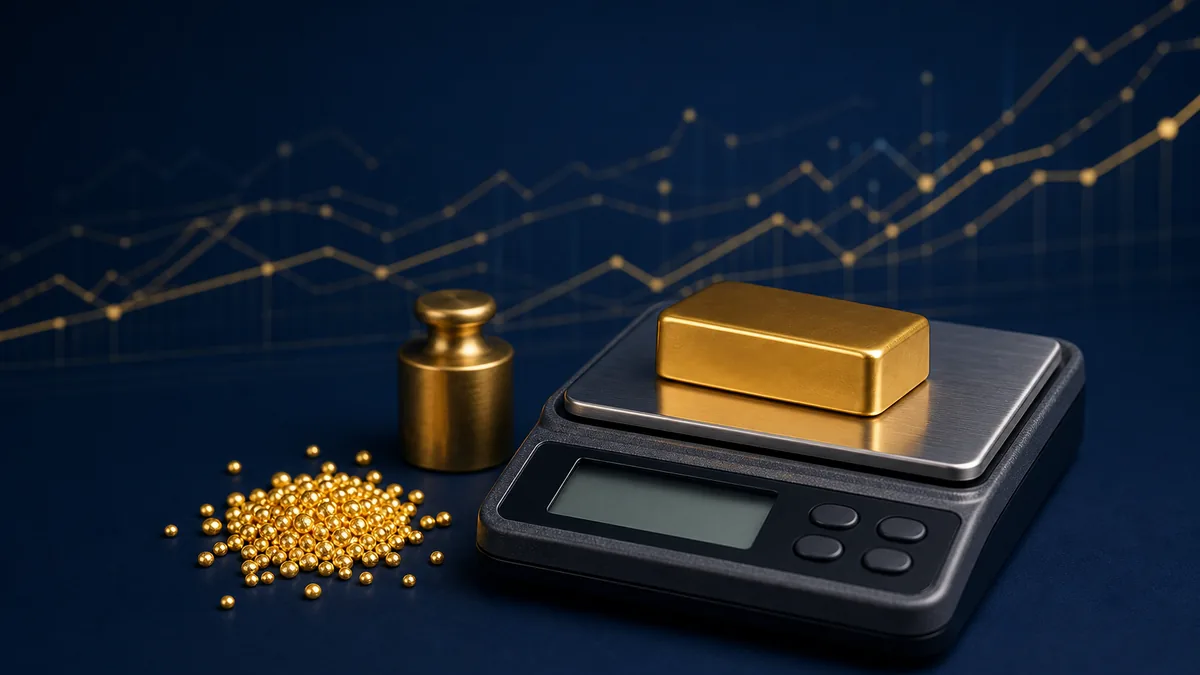
Gold price per gram starts with a troy ounce
Gold is usually quoted per troy ounce, while small bars and jewelry are often weighed in grams. That mismatch creates an easy mistake: dividing the quoted gold price by the number of grams in an ordinary household ounce.
A troy ounce is heavier. The conversion table in NIST Handbook 44 gives one troy ounce as 31.1034768 grams. An avoirdupois ounce, the unit used for groceries and most everyday goods in the United States, is 28.349523125 grams. Gold uses the first number.
The basic conversion is:
Gold price per gram = gold price per troy ounce / 31.1034768
That gives the value of one gram of pure gold before any dealer spread, fabrication charge, sales tax, shipping cost, or collectible premium.
A clean conversion example
Suppose the quoted price is a hypothetical $3,100 per troy ounce. This is an example for showing the math, not a current market quote.
$3,100 divided by 31.1034768 equals about $99.67 per gram of pure gold.
A 10-gram bar containing 99.9% gold would have an estimated metal value of:
10 x $99.67 x 0.999 = about $995.70
The retail price can be higher because a mint, refiner, wholesaler, payment processor, and dealer may each have costs to recover. A dealer's buyback quote can be lower. The gap between those prices is not an error in the gram conversion; it is the part of the transaction that the spot calculation does not cover.
You can run the same estimate with the Gold & Silver Value Calculator. The calculator accepts weight in troy ounces, so divide a gram weight by 31.1034768 before entering it. Ten grams, for example, is about 0.3215 troy ounce.
Why using 28.35 grams gives the wrong answer
An ordinary ounce contains about 28.35 grams. Substituting that number makes the calculated per-gram price roughly 9.7% too high.
The word "ounce" is doing too much work here. Bathroom scales, recipes, parcel weights, and precious-metal quotes do not all use the same ounce. When a gold quote simply says "per oz," the market convention is a troy ounce.
This also matters when checking the weight of a product. A bar labeled 1 oz in the bullion market generally refers to one troy ounce of metal, not the lighter household ounce. Grams avoid the naming problem, but only if the quoted ounce price is converted with the troy figure.
Purity changes the metal value
The pure-gold price per gram is only the first step. Jewelry and some bullion coins contain other metals for color, durability, or minting requirements.
Multiply the pure-gold gram price by the item's gold fineness:
Gold value per gram at a given purity = pure-gold price per gram x fineness
Common labels translate this way:
- 999 or 999.9 fine gold is 99.9% or 99.99% gold.
- 22-karat gold is approximately 91.67% gold.
- 18-karat gold is 75% gold.
- 14-karat gold is commonly 58.5% gold.
Using the hypothetical $3,100-per-ounce quote, pure gold works out to about $99.67 per gram. At 18 karats, the gold content is worth about $74.75 per gram before other adjustments. At 14 karats and 58.5% purity, it is about $58.31 per gram.
Karat is not the same as weight. "18K" describes the share of gold in the alloy. A scale still supplies the grams. Both are needed to estimate metal value.
Gross weight is not always gold weight
A necklace may weigh 20 grams without containing 20 grams of gold alloy. Stones, clasps, steel springs, solder, enamel, and non-gold settings can add weight. A dealer or refiner may subtract those parts before testing the remaining material.
Purity stamps are useful clues, but they are not a substitute for a reliable test when money is changing hands. Wear, repairs, mixed components, or a false hallmark can make the actual gold content different from the stamp.
For a rough jewelry estimate, the calculation is:
Estimated melt value = net metal weight in grams x pure-gold price per gram x tested fineness
"Net metal weight" is the difficult input. If stones and non-gold parts cannot be separated or estimated, the answer should be treated as a range rather than a precise appraisal.
Spot price, benchmark price, and live quote are not identical
The LBMA precious-metal prices page says the LBMA Gold Price is set twice daily through independently operated auctions beginning at 10:30 and 15:00 London time. That benchmark has a particular time and method behind it.
A live website quote may instead follow futures prices, wholesale dealer quotes, or a market-data feed that updates continuously. Two screens can show slightly different gold prices because their sources, timestamps, currencies, or data delays differ.
Before converting a quote, check:
- whether it is stated per troy ounce;
- which currency it uses;
- when it was last updated;
- whether the figure is a bid, ask, midpoint, benchmark, or delayed reference price.
A perfectly executed conversion cannot fix a stale or misunderstood starting quote. For more on the forces behind the quote itself, see why gold prices move and the broader Gold & Silver section.
Melt value is not a guaranteed sale price
Melt value estimates the contained metal at the reference price. It does not promise that a dealer will pay that amount.
A transaction can differ because of:
- the dealer's bid-ask spread;
- assay or refining costs;
- the size and recognizability of the bar or coin;
- local demand and available inventory;
- payment, insurance, shipping, and storage costs;
- sales or use taxes where applicable;
- collectible value that has little to do with metal content.
Small products often carry a larger percentage premium than large bars because fabrication and handling costs are spread across less gold. Jewelry resale can be especially far from the original retail price because workmanship and store markup may not be recovered as metal value.
Collectible coins need a different analysis. Rarity, condition, provenance, and buyer demand can matter more than melt value. A gram calculation is still useful, but only as the metal-value floor in a much wider pricing discussion.
Check the quote before sending money
The Commodity Futures Trading Commission's precious-metals fraud advisory warns about guaranteed-profit pitches, financed metal purchases, unclear storage arrangements, phony interest charges, and undisclosed commissions. A polished sales presentation does not prove that metal was purchased or stored as promised.
For a physical-gold quote, ask for the product weight, purity, total price, per-unit premium, payment fee, delivery or storage charge, and buyback terms in writing. Then compare the all-in price with the metal value calculated from the same timestamp and currency.
The conversion itself takes one line. The harder work is identifying what the quote includes.
Quick checklist
- Confirm that the starting quote is per troy ounce.
- Divide by 31.1034768 to get the pure-gold price per gram.
- Multiply by tested purity or fineness.
- Use net gold-alloy weight, excluding stones and other materials where possible.
- Add or subtract premiums, spreads, taxes, and fees separately.
- Label any market price with its source, currency, and time.
A gold price per gram is a unit conversion, not an appraisal or an offer. It gives you a common base for comparing products and checking dealer math without pretending every gram of gold trades at the same final price.
Educational only. This article provides general information and hypothetical examples, not personalized financial, investment, tax, legal, or trading advice.
Sources
- NIST Handbook 44, Appendix C - U.S. unit-conversion tables, including the troy-ounce-to-gram conversion.
- LBMA precious-metal prices - information on the LBMA Gold Price auction schedule and benchmark prices.
- CFTC: Precious Metals Fraud - warning signs involving financed purchases, storage claims, commissions, and guaranteed-profit pitches.