
Debt payoff calculator with extra payments: where should the extra money go?
A debt payoff calculator with extra payments can show that paying more generally reduces time and interest. The harder question is where the extra money should go when there are several balances.
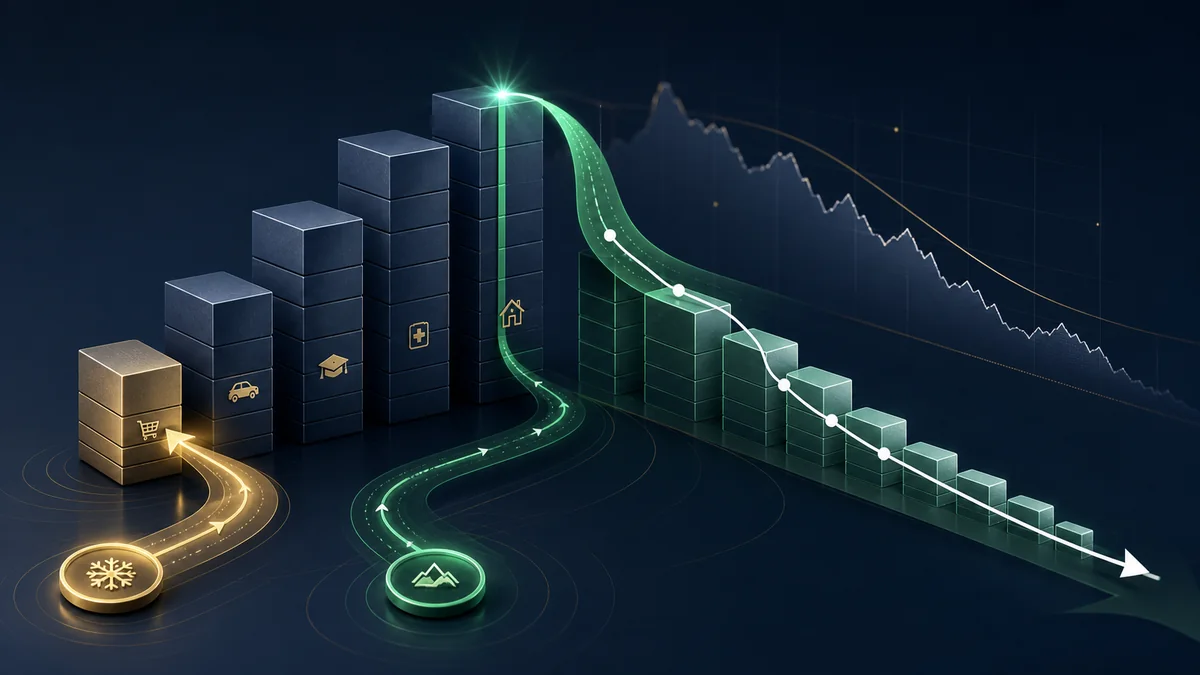
Two methods dominate that discussion. The debt avalanche targets the highest annual percentage rate first. The debt snowball targets the smallest balance first. One is designed to minimize interest mathematically; the other is designed to create a faster visible win.
Use the Debt Avalanche vs Snowball Calculator to compare the first target under each method. Then use the Debt Payoff Calculator to estimate payoff timing for an individual balance.
How the debt avalanche works
The avalanche method keeps minimum payments current on every account and directs extra money toward the debt with the highest APR. When that account is paid off, its full payment rolls to the next-highest APR.
This usually minimizes interest because the most expensive balance is attacked first. A high-APR credit card can generate much more monthly interest than a lower-rate auto or student loan, even when the lower-rate balance is larger.
The method works best when the borrower can stay motivated without an early payoff milestone.
How the debt snowball works
The snowball also keeps minimum payments current, but the extra amount goes to the smallest balance. Paying off that account frees a payment and creates a visible reduction in the number of bills.
The snowball can cost more interest when the smallest balance does not have the highest APR. Its potential advantage is behavioral: progress may feel faster, and a plan that a household follows can outperform a mathematically perfect plan that gets abandoned.
How to compare them honestly
Make a complete list containing:
- Current balance.
- APR, including when promotional rates end.
- Minimum payment.
- Due date.
- Any deferred-interest or collateral risk.
Do not automatically include every obligation in one list. A delinquent secured debt, tax debt, court obligation, or account with a promotional deadline may require different priority. The Consumer Financial Protection Bureau’s consumer debt resources can help readers understand rights and documentation, but individual legal or repayment questions may require qualified help.
What extra payments can change
An extra payment reduces principal, which reduces future interest. Its effect grows when:
- The APR is high.
- The extra payment begins early.
- New charges stop.
- The payment is applied consistently.
Try the calculator with the amount you are confident you can repeat. Then test a temporary larger payment from a refund, bonus, or expense reduction. Do not count irregular income until it actually arrives.
Watch for the “minimum payment” trap
Credit card minimums often change as the balance changes. Paying only the required minimum can stretch repayment for years. A fixed payment that stays level as the balance falls usually produces a clearer payoff path.
The Credit Card Payoff Calculator estimates payoff time under a fixed payment. The Emergency Fund Calculator helps protect the plan from being reversed by the next repair or medical bill.
Which method should you choose?
Choose avalanche when reducing interest is the main goal and you can stay consistent. Choose snowball when a quick account payoff would materially improve motivation or simplify cash flow. A hybrid can target one small balance first, then switch to highest APR.
The most important step is not the label. It is making payments on time, stopping the balance from growing, and directing a repeatable extra amount toward one priority at a time.
Educational only. This is not personalized financial, credit, legal, or tax advice.