
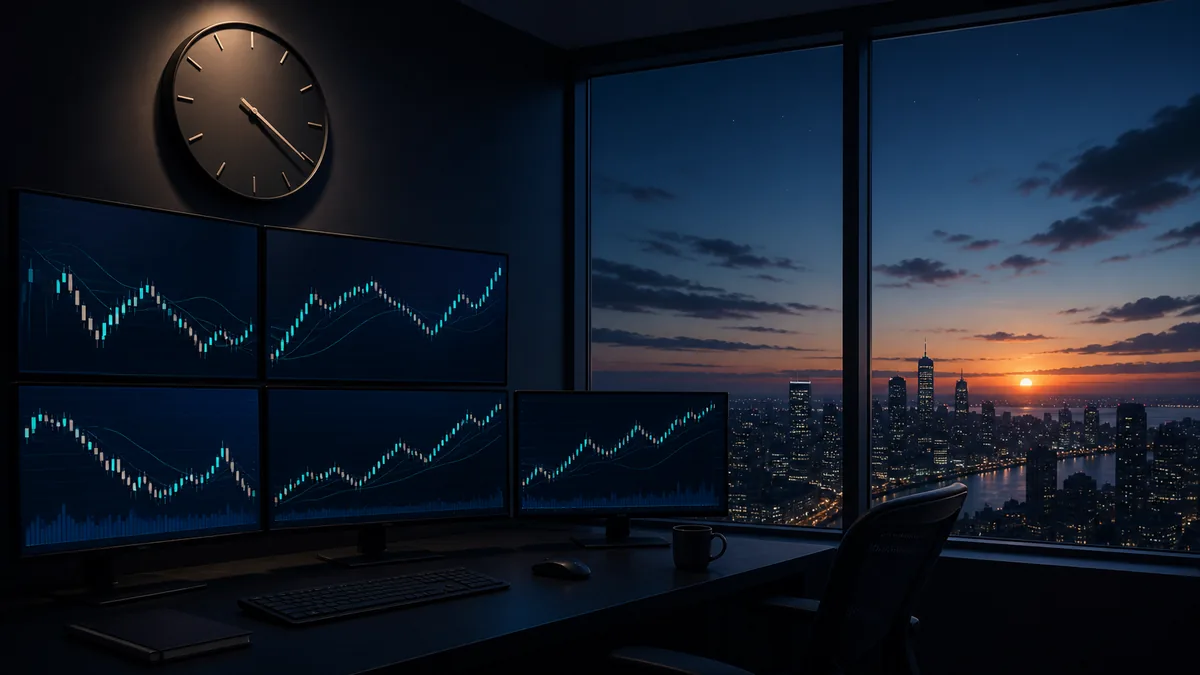
24-hour stock trading changes more than the clock
A stock can have a price at midnight. That does not mean its midnight market works like the one at noon.
The SEC has scheduled a September 17, 2026 roundtable on moving U.S. equity markets toward 24-hour trading. The agency said the discussion will cover overnight operations, resilience, investor protections, and the practical work needed to support longer hours. It did not announce that every U.S. stock exchange is now open around the clock.
Some brokers already let customers trade certain stocks overnight. Their hours, eligible securities, order types, and trading venues differ. An app that displays an overnight quote may be showing activity from a specific venue rather than the broad market people picture when they hear "stock market today live."
That distinction matters. Access to a trade and access to a deep, competitive market are separate things.
Regular, extended, and overnight hours
FINRA describes regular trading hours for listed stocks as 9:30 a.m. to 4 p.m. Eastern time. Trading before 9:30 a.m. is commonly called premarket trading, while trading after 4 p.m. is called postmarket or after-hours trading.
The labels get less consistent after that. FINRA gives 7 a.m. to 9:30 a.m. as a typical premarket window and 4 p.m. to 8 p.m. as a typical after-hours window. It describes 8 p.m. to 4 a.m. activity as overnight trading. A broker may use different boundaries or offer only part of those sessions.
"24-hour" also may not mean 24 hours on every calendar day. A service can run nearly around the clock on weekdays, pause for maintenance, close for weekends, or treat the evening as the start of the next trading day. Check the broker's actual schedule rather than relying on the label.
Regular exchange hours still have special importance. FINRA notes that the 4 p.m. exchange price is the official close used by funds to value holdings. An overnight trade does not rewrite that official closing price. Nor does the final overnight trade dictate the next official opening price, which is formed from orders available around the open.
An overnight quote may represent a thinner market
A quote is only as useful as the orders behind it. When many buyers and sellers compete, an order usually has a better chance of filling near the displayed market price. Overnight sessions tend to have fewer participants and fewer orders.
FINRA warns that lower liquidity can lead to partial fills or no fill at all. It can also leave more room between the best available buying and selling prices.
That gap is the bid-ask spread. Suppose an overnight screen shows a bid of $49.50 and an ask of $50.50. The $1 spread is part of the immediate cost of trading. A chart may plot the last trade at $50, but a buyer cannot assume shares are available at that exact number.
Last price, bid, and ask answer different questions:
- The last price is where the most recent trade occurred.
- The bid is the highest displayed price a buyer is offering on that venue.
- The ask is the lowest displayed price a seller is requesting on that venue.
A stale last trade can sit between a bid and ask that have already moved. On a thin overnight screen, the last trade may also involve very few shares. Read the quote details before treating one number as the stock's current value.
Price discovery can be split across venues
During regular hours, the National Best Bid and Offer combines protected quotations across registered exchanges. FINRA says the NBBO is published only during regular trading hours. Extended-hours systems may not be linked in the same way.
As a result, two brokers can show different overnight prices for the same stock at the same time. One venue may have a willing seller at $20.10 while another has one at $20.25. A customer whose broker routes only to the second venue may not reach the first quote.
This is not necessarily a bad data feed. It can be a real difference in which orders each venue can see and execute. The broker's extended-hours disclosure should explain where it routes orders and what price protections apply.
The same issue makes an overnight market chart easy to misread. A rising line may capture trades from one venue with light volume. It does not prove that every venue has the same bid, ask, depth, or direction.
News can hit when fewer orders are available
Companies often release earnings and other announcements outside regular hours. Economic and geopolitical news can arrive at any time. Overnight access lets market participants react sooner, but the first reaction can be rough.
FINRA's model risk disclosure connects news announcements with lower liquidity and higher volatility. A small set of aggressive orders can move a thin market quickly. Later participants may interpret the news differently, and deeper regular-hours trading can produce another price.
The overnight move is real for anyone who traded at that price. It is not a guaranteed preview of the opening price.
This makes screenshots particularly weak evidence. A screenshot usually leaves out the venue, timestamp, spread, share size, and whether the figure was a last trade or a live quote. It can preserve the most dramatic point while losing the market conditions that produced it.
Why limit orders show up so often overnight
A market order asks for immediate execution at the best price available to the broker. It controls urgency, not price. In a market with a wide spread or shallow order book, the execution can be far from the number that appeared on screen a moment earlier.
A limit order sets the highest price a buyer will pay or the lowest price a seller will accept. It limits price but does not guarantee execution. The order can remain unfilled even if a chart appears to touch the limit, because another venue may have printed the trade or earlier orders may have used the available shares.
Many brokers accept only limit orders during extended hours. That restriction addresses price uncertainty, but it does not make the session safe or ensure a competitive fill.
Time instructions matter too. FINRA's order-qualifier guide says customers may need to specify whether a day order should remain active during extended hours. Brokers can cancel an unfilled overnight order at the session boundary, carry it into another session, or require a separate selection for regular-hours trading. The app's review screen should state the session, limit price, share count, and expiration before the order is submitted.
A checklist for reading a live overnight market screen
Before relying on an overnight quote, identify what the screen is actually displaying:
1. Which trading venue supplied the quote or last trade? 2. Is the number a bid, ask, midpoint, or last transaction? 3. How wide is the bid-ask spread? 4. How many shares are available at the displayed bid and ask? 5. When did the last trade occur? 6. Does the broker accept only limit orders? 7. Which stocks and exchange-traded funds are eligible? 8. When will an unfilled order expire? 9. Will the order remain active when regular trading begins? 10. Are options or fractional shares excluded?
The broker's risk disclosure is worth reading. FINRA Rule 2265 requires a firm to provide customers with extended-hours risk information before allowing them to trade in those sessions. The model disclosure covers lower liquidity, greater volatility, changing prices, unlinked markets, news announcements, and wider spreads.
Longer hours do not change investment math
A longer trading day creates more possible execution times. It does not improve a company's cash flow, reduce a fund's expense ratio, or make a concentrated portfolio more diversified.
The Portfolio Rebalancing Calculator can show how far a simple portfolio has moved from a target stock allocation. The calculation uses holdings and targets, not the hour at which a quote happened. If an overnight move changes the inputs, it may change the estimated rebalance amount, but the calculator does not recommend a trade or account for spreads, taxes, and routing.
For broader market explainers, see the Markets section and the guide to stock and bond reactions to a weak jobs report. Those pages separate the economic signal from the first market move, a useful habit when an overnight chart is swinging on fresh news.
What the SEC roundtable does and does not mean
The SEC's July 23 announcement says the September roundtable will discuss preparations for 24-hour equity trading, including operations and resilience. It also invites public comments under File Number 4-913. The event is a policy discussion, not a final rule or a declaration that the transition is complete.
There are hard plumbing questions behind the convenient app interface. Trading venues, brokers, clearing systems, market-data services, issuers, and regulators need to handle maintenance, corporate actions, trade dates, settlement, surveillance, outages, and customer support across a much longer operating window. Investor protections also have to make sense when activity is spread across sessions and venues.
The practical takeaway is less dramatic than "the stock market never closes." Overnight trading is already available in parts of the U.S. market, and regulators are discussing broader support for it. Anyone reading those prices still needs to know which session, venue, quote type, and order rules sit behind the screen.
Educational only. This article provides general market information, not personalized financial, investment, legal, or trading advice.
Sources
- SEC: Roundtable on Preparations for 24-Hour Trading - roundtable date, scope, public access, and File Number 4-913.
- FINRA: Extended-Hours Trading: Know the Risks - session definitions, liquidity, volatility, venue linkage, official closing prices, and broker restrictions.
- FINRA Rule 2265: Extended Hours Trading Risk Disclosure - required customer disclosure and the model list of extended-hours risks.
- FINRA: Trading Terms, Time Parameters and Qualifiers on Stock Orders - day orders, extended-hours instructions, partial fills, and routing terms.